Published at December, 12 2023
Updated on July, 28 2026
Be wildfire smart – act fast, act right!
Share the page

Once again, the French Ministry for Ecological Transition, Biodiversity and International Negotiations on Climate and Nature and the French Ministry of the Interior, are lauching the annual public awareness and prevention campaign about wildfires. Better safety practices can save lives.
Public awareness campaign poster


Understanding nature-related risks and how to stay safe
Boasting 17.6 million hectares of forest in Metropolitan France and Corsica, France has one of the largest forest areas cover in Europe. Its vast wooded areas make France prone to wildfires, especially in the summer season.
What to do in case of a fire outbreak
Raise the alarm
If you notice a fire outbreak, alert emergency services by calling 112 (European emergency number), 18 (firefighters) or 114 (for the hard of hearing) and try to locate the fire from a safe distance.

Protect yourself
Take shelter in a cleared property until the intervention of the emergency services. No car can be considered as a safe place because it may catch fire easily.

Stay informed
Stay up-to-date with the situation and follow the instructions provided by the emergency services or city council.

How to prevent fire outbreaks
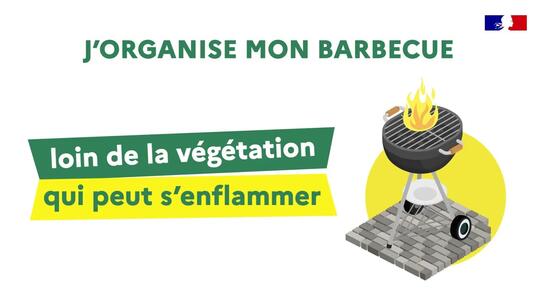
Fire and barbecue
Hold barbecues on the terrace of your property, far away from vegetation.

Cigarette butts
Stub your cigarettes in an ashtray.

Sparks from work tools
Carry out DIY work far enough from the lawn and dry grass and keep a fire extinguisher nearby, just in case.

How to protect yourself at home in case of fire
Garden hose
Store the garden hose indoors before the fire reaches your property. You may need it to extinguish the smoldering embers once the fire has died down.

Ventilation
Block air vents and cover door gaps to prevent toxic smoke and sparks from entering your home.

Damp cloth
Cover your nose and mouth with a damp cloth to protect yourself from the smoke.

Preventive actions to protect your home
Fuel
Store flammable materials and substances (wood, gas cylinders) in a shed away from your house.

Ground clearing
Before the summer, clear the area all around your house, cutting back low vegetation and trimming trees to keep some space between them. The aim is to prevent the fire from reaching your house, which is mandatory in fire risk areas.

House design
If you live in an area regulated by a Forest Fire Risk Prevention Plan, make sure your house meets safety standards (shutters, gutters, roofing, ventilation, etc.).

90% of homes destroyed in wildfires either lack proper brush clearance or have it done inadequately
Whether you are a homeowner or an elected official, this page provides all the information you need to understand the clearing legal obligations and offers practical guidance on how to effectively carry out clearing on your property.
The Georisques platform enables you to stay informed about fire risks in your area.
Since June 2023, Météo-France has been publishing a daily Wildfire Risk Forecast covering metropolitan France and Corsica. This forecast assesses the level of wildfire danger based on several meteorological factors that play a key role in the outbreak and spread of fires, including rainfall, air humidity, temperature, wind conditions, and vegetation dryness.
Published every afternoon on the meteofrance website and mobile app, the forecast provideswildfire risk information for the next two days, which is presented on two maps: one for the following day and another for the day after. Four danger levels are displayed for each department using the following colour code: low (green), moderate (yellow), high (orange) or very high (red).
The Wildfire Risk Forecast does not provide information about current or upcoming fires.
For more detailed information on access restrictions and permitted activities in forest areas, please visit your local prefecture’s website.
Watch the video to learn the best practices to adopt
Après un feu de forêt, ce qu'il faut savoir
Même si le feux est fixé ou éteint.
Je ne me rends pas sur place pour ne pas encombrer les accès et laisser l'espace aux services de secours.
Les pompiers peuvent avoir besoin de plusieurs jours pour éteindre complétement le feu et sécuriser la zone.
Une fois le feu éteint, les chutes d'arbres, de rochers sont fréquentes et des glissements de terrain sont possibles.
J'évite aussi de me mettre en danger et de gêner les opérations de sécurisation.
Pour la faune et la flore, le milieu est particulièrement sensible après un feu.
Je laisse les professionnels et associations, en lien avec les autorités locales prendre les mesures nécessaires.
Je me tiens informé auprès de ma préfecture pour savoir quand je serai à nouveau autorisé à me rendre sur les lieux.
Je suis strictement les consignes des autorités locales.
Nos partenaires
Ils sont engagés dans la campagne de prévention des feux de forêt et de végétation.


